Moisture Resistance in Finger Joint Pine Plywood: What Buyers Need to Know
Selecting wood panels for construction, cabinetry, or furniture manufacturing requires a thorough understanding of how materials interact with environmental moisture. Among the wide range of engineered timber products available, finger joint pine plywood occupies a unique position. It combines the cost efficiency of fast-growing softwoods with the enhanced dimensional stability achieved through precision joinery and cross-lamination. However, because pine is inherently susceptible to moisture absorption, evaluating the water resistance of finger joint pine panels is a critical step for wholesale buyers, project managers, and furniture makers.
Moisture exposure can lead to swelling, thickness expansion, surface mold, bond failure, and long-term structural decay. Understanding the structural dynamics, adhesive technologies, and production standards that define moisture resistance allows procurement teams to specify the correct panel grade for their target application. Looking beyond surface finishes to examine the internal construction of finger joint pine plywood reveals how performance can be maximized across various relative humidity levels and ambient conditions.
The Structural Anatomy of Finger Joint Pine Plywood
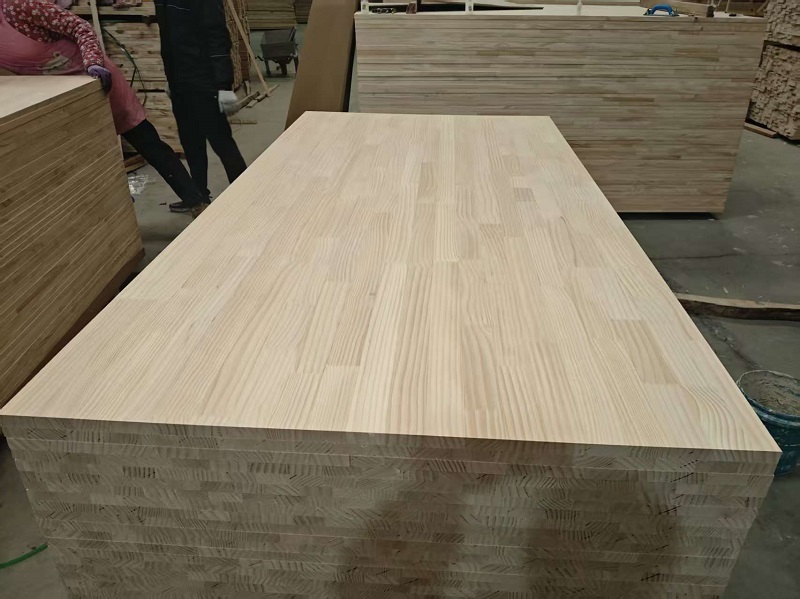
To understand how finger joint pine plywood resists water, one must first look at its internal geometry. Standard plywood consists of thin wood veneers glued together with alternating grain directions. In finger joint pine plywood, the core veneers or solid blockboard cores are composed of shorter pine timber strips joined end-to-end using interlocking, comb-like profiles known as finger joints.
These interlocking fingers create a mechanical bond over a large surface area, allowing smaller timber pieces to be joined into long, stable strips. Once these strips are assembled, they form the core layers, which are then capped on both sides with smooth outer pine veneers or hardwood faces under heat and hydraulic pressure.
This hybrid construction provides several key structural characteristics:
- Relieved Internal Stresses: Natural solid pine contains continuous grain lines that warp, cup, or twist when moisture levels fluctuate. Cutting pine into shorter strips and rejoining them via finger joints breaks up these continuous tension lines, yielding a core panel that remains flatter under changing atmospheric humidity.
- Tight Core Interlocking: High-precision finger joint machinery cuts clean, interlocking profiles that fit together with minimal internal void space. Fewer internal gaps mean fewer pockets where trapped water or moisture vapor can condense and weaken the structure.
- Balanced Grain Orientation: Like conventional plywood, alternating the grain angles between adjacent core layers distributes moisture-induced expansion across two axes rather than a single direction, mitigating major dimensional changes.
Resin Chemistry: The Core of Water Resistance
While the mechanical joinery of finger joint pine contributes to overall stability, the ultimate barrier against water damage is the adhesive system. No matter how tightly pine blocks are jointed, the panel will fail under damp conditions if the glue dissolves or degrades when exposed to liquid water or elevated ambient humidity.
Manufacturers utilize different resin types depending on the intended exposure level and performance classification of the final panel:
- Urea-Formaldehyde (UF) Resins: Best suited for interior applications where humidity remains consistently low and controlled. UF resins offer excellent bond strength in dry indoor settings but degrade rapidly when exposed to direct water, high ambient humidity, or condensation. Panels built with standard UF glue are appropriate for dry interior furniture, interior decorative trim, and indoor cabinetry.
- Melamine-Urea-Formaldehyde (MUF) Resins: Formulated by introducing melamine into standard urea resin, this adhesive provides enhanced water endurance. MUF adhesives can withstand periodic dampness, high room humidity, and indirect moisture without immediate bond degradation. Panels bonded with MUF are frequently specified for kitchen cabinetry sub-assemblies, bathroom furniture frames, and temporary protective structures.
- Phenolic Resins (PF): Known for producing dark glue lines, phenolic adhesives form an irreversible chemical bond that resists boiling water, continuous outdoor weather, and cold water immersion. Phenolic resins are essential for exterior-grade plywood, structural formwork, and heavy-duty industrial paneling where moisture exposure is ongoing and severe.
- Polyurethane and Isocyanate Adhesives: Often used specifically for the finger joint seams themselves, these solvent-free adhesives create flexible, waterproof joints that accommodate slight micro-expansions of the pine fibers without cracking or shearing.
Evaluating adhesive ratings involves checking standard testing designations such as MR (Moisture Resistant), WBP (Water Boiled Proof), or specific EN/BS performance standards. MR grade generally indicates resistance to cold water and damp air for short durations, whereas WBP grade signifies long-term endurance against continuous water immersion and severe environmental weathering.
How Pine Wood Density and Microstructure Interact with Moisture
Beyond the glue lines, the physical nature of pine wood plays a central role in panel performance. Pine species commonly used in finger joint panel manufacturing—such as Radiata Pine, Sylvestris Pine, or Slash Pine—are classified as softwoods. Softwoods generally possess a lower density and a more open cell structure than dense hardwoods like birch or beech.
This porous microstructure means that unsealed pine fibers act as capillary tubes, drawing liquid water into the interior of the board. When pine absorbs moisture, individual wood cells swell across their radial and tangential axes. If the swelling force exceeds the shear strength of the resin, delamination occurs.
However, finger joint construction alters this behavior in several distinct ways:
- Distributed Swelling Vectors: In solid pine boards, moisture absorption causes uniform swelling across the entire width, often resulting in severe cupping or bowing. In a finger joint pine core, each individual strip expands independently in micro-directions, canceling out macro-level warping across the complete sheet.
- Variable Density Zones: Pine logs exhibit distinct rings of fast-growing earlywood (lighter and more porous) and latewood (darker and denser). Finger jointing mixes these growth rings randomly across the panel core, equalizing moisture absorption rates throughout the sheet rather than concentrating expansion in soft earlywood bands.
- Edge Sealing Sensitivity: The exposed finger joint seams along the cut edges of a plywood panel represent primary pathways for moisture intake. Water penetrates end-grain fibers significantly faster than face veneers, making proper edge sealing essential for maintaining structural integrity in moist environments.
Manufacturing Precision and Its Effect on Panel Longevity
Moisture resistance is not solely a matter of raw materials; manufacturing control significantly dictates how a panel behaves when exposed to damp air. Precision processing directly impacts how effectively the resin layers isolate wood fibers from environmental humidity.
Key manufacturing factors influencing moisture durability include:
- Moisture Content at Assembly: High-quality finger joint pine plywood requires timber strips dried to a stable moisture content—typically between 8 percent and 12 percent—prior to finger jointing and face bonding. If wet pine strips are glued together, locked-in moisture causes internal stress, seam splitting, and bond failure as the finished panel dries in service.
- Finger Joint Milling Tolerance: Microscopic gaps within poorly cut finger joints allow moisture vapor to collect inside the core. Tight joints with consistent pressure distribution form an uninterrupted barrier of compressed wood fibers and solid resin.
- Pressing Temperature and Cycle Time: Hot-pressing cures the adhesive fully across the entire sheet surface. Insufficient press times or uneven heat application result in un-cured resin pockets, which dissolve or fail quickly when exposed to ambient moisture.
- Sanding and Surface Smoothness: Smooth, uniformly sanded outer veneers allow topcoats, primers, and waterproof laminates to adhere evenly. Rough or uneven surfaces create microscopic voids in protective coatings through which water droplets can breach the underlying pine.
Practical Applications and Moisture Grade Selection
Selecting finger joint pine plywood requires matching the moisture resistance profile of the panel to the specific environment in which it will be installed. Over-specifying panel grade increases material costs unnecessarily, while under-specifying leads to premature panel failure and repair expenses.
Dry Interior Environments
For standard furniture, wardrobe carcasses, bedroom shelving, and interior decorative wall cladding, dry-use finger joint pine plywood bonded with standard MR adhesive is suitable. In these spaces, relative humidity generally stays below 60 percent, and direct contact with water does not occur. The natural grain figure of pine provides an attractive surface for clear lacquers or paint finishes.
High-Humidity Interior Spaces
In kitchens, bathrooms, laundry rooms, and basement storage spaces, panels face high relative humidity and occasional water splashing. Specifying finger joint pine plywood made with MUF resin or moisture-resistant face veneers ensures the core remains stable. Edge banding or liquid edge sealants should be applied to prevent moisture from creeping into the exposed finger joints along the perimeter.
Structural and Semi-Exterior Uses
For outdoor furniture frameworks, soffit linings, temporary site hoardings, or packaging containers exposed to weather, panels must feature WBP phenolic adhesive bonds. While finger joint pine plywood is rarely recommended for raw, unshielded ground contact, exterior-grade panels perform reliably when combined with high-grade exterior paints or protective overlays.
Best Practices for Storing, Handling, and Sealing Panels
Even high-grade moisture-resistant finger joint pine plywood requires careful handling to maintain its dimensional stability throughout transit, storage, and installation. Adhering to simple job site guidelines prevents moisture-related defects:
- Acclimation Prior to Processing: Panels should be stored flat in the target installation environment for 48 to 72 hours before cutting or finishing. This allows the internal moisture content of the pine to equalize with local atmospheric conditions.
- Elevated Storage Off Concrete Floors: Raw concrete slabs transfer ground moisture directly into bottom panels. Storing sheet goods on level timber dunnage elevated off the floor protects edge seams from capillary water intake.
- Immediate Edge Sealing After Cutting: Cutting a panel exposes raw end grain and internal finger joint lines. Applying a coat of waterproof sealer, polyurethane primer, or acrylic edge paint immediately after cutting seals these open pathways against moisture ingress.
- Comprehensive Surface Coating: Sanded pine surfaces absorb atmospheric moisture even through thin decorative stains. Applying complete topcoats—including clear lacquers, paints, or wax oil finishes—to both sides and all edges ensures balanced moisture protection and prevents panel bowing.
Evaluating finger joint pine plywood requires looking beyond simple thickness measurements to assess resin chemistry, core assembly precision, and raw material preparation. When selected according to appropriate exposure ratings and sealed correctly during fabrication, finger joint pine panels provide a dependable, highly stable, and cost-effective surface for diverse construction and millwork projects.
Bothbest is a dedicated factory and supplier specializing in high-quality MOSO bamboo flooring, outdoor bamboo decking, and bamboo panel products based in China. Manufacturing durable, eco-friendly materials engineered to withstand diverse environmental conditions, Bothbest serves global clients with customized bamboo solutions for sustainable residential and commercial projects.